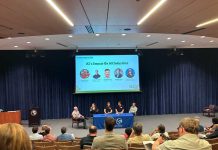
Last Thursday, the Network for Entrepreneurs in Wilmington (essentially comprised of the Wilmington ecosystem’s human megaphone, Jim Roberts) held its annual “Investor Buzz In.” The event took place at Cape Fear Community College and notably doubled as a “910 Day” celebration—another Jim creation capitalizing on the Wilmington area code.
Held annually for four years now, the Investor Buzz In is a one-day venture capital conference that gathers innovation leaders from around the state (and beyond) and promotes both existing and potential growth in the coastal ecosystem.
This all takes the form of a series of fireside riverside chats, panel discussions, reverse investor pitches, and presentations from local founders, ultimately comprising a full day’s worth of programming.
If you want the quick version of the recap*, it’s basically this: 322 people registered at no cost for 300 seats at an event that roped in something of a who’s-who of North Carolina investors, entrepreneurial support folks, niche nonprofit journalists, and coastal founders. Attendees were treated to remarks that, in essentially equal measure, celebrated what’s working in Wilmington and spoke to what’s still needed for this or any other ecosystem to reach its potential.
For the more in-depth version, read on for a session-by-session recap of speakers, participants, and notable words of wisdom from the event….
*And if you want the all-caps version, see Jim’s LinkedIn.
Riverside Chat: Leadership In The Community From The Private Sector
Chris William (PBS host) moderating, with Mike McGuire (formerly CEO of Grant Thornton)
This opening “riverside” chat functioned essentially as an instructional interview with Mike McGuire, who was the CEO of Grant Thornton LLP until his retirement in 2020 (and who was once recognized by the Charlotte Business Journal as the “Most Admired CEO” in that capacity). While the conversation touched on numerous aspects of McGuire’s experience, the prevailing insights concerned the culture and mindset required to build and run a successful company.
Key Quotes/Takeaways:
- “It’s hard to fix the culture if you’re starting with the wrong people…. 1+1 becomes 7 or 8 or 10 if you have the right people.”
- “An entrepreneur has to be curious to be able to change things, and so you’ve got to have that mindset in an organization.”
Panel Discussion: Programming For Entrepreneurs That Has An IMPACT

Emil Runge (Executive Director, Launch Chapel Hill) moderating, with Taylor McLemore (Venture Partner, Launchpad), Tom Snyder (VP of Programs, NC IDEA), Hal Atkins (Owner, Companah), Lydia Thomas (Program Manager, UNCW CIE)
The day’s first panel was comprised of speakers with experience covering different angles of entrepreneurial support programming. True to the title, they discussed some of the features that can make something like an accelerator program more (or less) successful. They also ventured into what they, as advisors and supporters, look for in entrepreneurs poised for success.
Key Quotes/Takeaways:
- The panelists opined that some accelerators “get it wrong” by focusing too much on steps in a way that might convey that there are uniform, straightforward processes (from “idea” to “customer discovery” and so on). The alternative most directly suggested by Tom Snyder is to teach habits:
- “The best programs and the best mentors are the ones that help you to build the right habits… customer discovery isn’t a step, it’s a habit.”
- They noted that one distinction that can point to a winning entrepreneur is that they’re more preoccupied with the problem they’re solving rather than their solution.
- As McLemore put it, “The people that fall in love with the problems are the ones that win.”
- Snyder added, “Nobody wants your solution; they want the outcome that solution creates.”
Reverse Pitches By Regional Investors
It is fair to say that one of the main focuses of the Network for Entrepreneurs in Wilmington is nourishing mutual awareness between regional investors and coastal innovators. A lot of energy, including at this event, goes into showcasing startups that are ready to raise and/or already doing so. The “reverse pitch” session is effectively the flip side to that coin (shoutout Robert De Niro from Heat), in this case giving seven investors a chance to speak about how they or their firms operate.
We won’t get into the differences in approaches here specifically, but here’s the list of featured regional investors:
- Abby Phillips (Wolfpack Investor Network)
- Robbie Allen (NC Tweener Fund Powered by NC IDEA)
- Paul Quadros (Band of Angels, California)
- Greg Brown (Charlotte Angel Fund)
- Mark Friedman (RTP Angel Fund)
- Virginie Raphael (Full Circle Fund)
- Richard Stroupe (Cape Fear Ventures)
Lunch Keynote Panel: Attracting More Local Investors

Richard Stroupe (Founder and Managing Partner, Cape Fear Ventures) moderating, with Jay Bigelow (Head of Founder Engagement, CED), Stan Parker (General Partner, WSPR Fund), Mark Friedman (Co-Founder, RTP Angel Fund), Jeremy Turner (Fund Manager, Appalachian Investors Alliance)
This panel touched on a number of different topics which, all together, more or less boiled down to the process of establishing the infrastructure for that thing we talk so much about—an ecosystem. Each panelist brought experience-backed perspectives on the resources, processes, and even mindsets required to establish foundations for long-term entrepreneurial support.
Key Quotes/Takeaways:
- On attracting investors and fostering investor activity, Bigelow noted, “Yes it’s about funding founders and companies, but investors want to talk to each other…. connecting investor to investor also helps founders find investors.”
- On the work required to build a lasting innovation community, Friedman said, “That ecosystem word is really important; it’s not just a word, it’s something that happens.” (Friedman)
- On how startups themselves can attract investor interest, Bigelow also stressed that sometimes it’s an underlying leadership move, rather than headline momentum, that does the trick; he pointed to an example of a founder attracting investor attention by putting the right person on a board, stating, “Traction can be lots of different things, it’s not always sales and revenue” and that founders should show investors that they’re ready to learn.
Panel Discussion: AI Impact On All Industries

Wade Minter (Founder and COO, Suggestion Ox) moderating, with Corbin Penland (Co-Founder and CEO, Synply), Stephen Perry (Founder and Executive Chairman, Kymanox), Robbie Allen (Founder and Managing Director, Automated Consulting Group), Christy Swann (Founder and CEO, RCOAST)
With panelists representing a wide range of industries and efforts (from streamlined loan syndication to data-driven coastal erosion management), this panel, too, lived up to its title. The members of the panel spoke to varying degrees about both broad and targeted AI implementation in their respective industries. Perhaps most interesting, though, were the responses when Minter asked the panelists how they go about pitching AI as an improvement, rather than as something scary or potentially detrimental.
Key Quotes/Takeaways:
- Penland talked about demonstrating the value of AI in “more isolated ways that still require human input” such that adaption to new technology can take place alongside optimism about the human side of the equation.
- Swann framed AI adoption as a way for founders to “optimize” their money, but argued for process improvement over job displacement within that idea.
- Perry added, “As long as you can kind of move where the cheese is moving, you’re going to be fine.”
Panel Discussion: Life Sciences
Carson Jackson (Commercialization Associate, NCInnovation) moderating with Dr. Morris Nguyen (Founder and CEO, Predicate), Paul Quadros (Band of Angels), Brett Lanier (President, Isosceles Pharmaceuticals)
This panel on life sciences innovation took place alongside a tech-oriented “startup speed networking” session outside of the main venue. The panel itself addressed (naturally) some of the processes that go into building life sciences companies in North Carolina. However, the speakers also ventured into some more general conversation about the importance of mentorship and community opportunities—and indeed events like the Investor Buzz In itself.
Key Quotes/Takeaways:
- Lanier praised the UNCW Center for Innovation and Entrepreneurship specifically, noting the resources available for entrepreneurs to take advantage of. He implied that specifically working with a scientific background, community support helps with the “trial by fire” of learning the entrepreneurship side of things.
- Nguyen recalled that working through a cohort with RIoT in Wilson had provided a good early spark, saying, “It really got us connected to other founders, and having that early guidance of good habits.”
Panel Discussion: Technology

Michelle Calton (Interim CEO, NC TECH) moderating, Tully Ryan (CEO, IQExit), Jenn Summe (General Partner, Primordial Ventures), Robin Cowie (Founder and CEO, Skillmaker), Matt Cimino (Investor, Amped Ventures)
With a mix of founders and funders speaking and NC TECH’s interim CEO moderating, this panel offered probably the most wide-ranging discussion. All told, the panelists covered investor perspective on founder assessment; founder perspective on growth and fundraising; and, ultimately, what Wilmington offers specifically for tech entrepreneurs.
Key Quotes/Takeaways:
- Offering investor perspective on assessing founders, Summe highlighted the importance of demonstrating consistency, specifically noting the appeal of a founder looping her in on regular update emails. This not only shows company progress, she argued, but also a tendency to follow through.
- Speaking about his startup’s recent raise, Cowie argued that founders should aim to get past theories and hypotheticals to attack their serviceable addressable markets and “sell the product as quickly as possible.”
- On building in Wilmington, Cowie added, “This place is like a tinderbox; if you have the right product you can meet the right people very quickly.”
- Ryan added that Wilmington has a particular opportunity to brand itself as an epicenter for fintech startup growth.
- Comparing Wilmington to other areas in the state, Cimino said, “You don’t have to be in Raleigh; I think there’s a fantastic network in Raleigh, but you can absolutely do it in Wilmington.”
- He added, crucially, “I think you can’t grab your beer and hop on a boat in Raleigh.”
Panel Discussion: The Future Of The Wilmington Ecosystem

Thom Ruhe (President and CEO, NC IDEA) moderating, with Heather McWhorter (Director, UNCW CIE), Richard Stroupe (Founder and Managing Partner, Cape Fear Ventures), Scott Davis (Wilmington Hub Director, NCInnovation), Dr. John Hardin (Executive Director, NCDOC Office of Science, Technology, and Innovation)
This panel of both statewide and Wilmington-specific ecosystem supporters rounded out the program with a specific focus on the coast. They largely discussed a combination of existing investments and initiatives concerning Wilmington’s growth and what is needed to spark the next chapters of that growth.
Key Quotes/Takeaways:
- On top of some discussion about specific, targeted investment, Ruhe talked about the intangible benefits, when building an ecosystem, that can make people feel hopeful about progress. He specifically noted the “activation” of Stroupe as a high-profile supporter of coastal entrepreneurs.
- On UNCW’s CIE, McWhorter said, “We are here for the community’s success in hopes of creating good-paying jobs for our graduates, in hopes of creating research opportunities… and in hopes of creating a vibrant community that everyone wants to live in.”
- Prompted to speak to who wasn’t in the room that ought to be, Davis pointed to elected officials (McWhorter echoed).
- Ruhe pointed out that North Carolina has three NSF-funded initiatives supporting research and innovation; Hardin jumped in to say we’re the only state that can make that claim.
Presenting Startups
Interspersed throughout the program outlined above were presentations from six Wilmington-area startup founders. Here’s a quick look at those companies:

RCOAST (Presented by Founder and CEO Christy Swann)
RCOAST is using drone-mounted LiDAR to generate models measuring coastal erosion and gathering data that can help to optimize mitigation efforts. Founder and CEO Dr. Christy Swann also made news during her presentation, announcing that RCOAST has closed a $945K pre-seed round.
(See GrepBeat’s feature on RCOAST here)

IQExit (Presented by CEO Tully Ryan)
IQExit presents a core solution called Exit Readiness Intelligence™, which is designed to project future deals and exit timelines for business owners—based on a combination of bank-supported self-assessments and existing banking relationship data. The platform then continues to update exit readiness data as the business grows and evolves.
(See GrepBeat’s feature on IQExit here)

Synply (Presented by Co-Founder and CEO Corbin Penland)
Synply is one of a handful of growing Wilmington startups to have been incubated within Live Oak Bank. Officially founded in 2024, the startup offers a comprehensive, cloud-based platform designed to improve loan syndication processes for banks. The platform handles the “cumbersome processes” and lets banks focus on relationships and monitoring.

Skillmaker (Presented by Co-Founder and Chief Sales Officer Nathan Munton)
Nuream is pioneering “Fabric-as-a-Sensor” (FaaS) technology to collect both brain and heart biosignals from sleepers through pillowcases and other fabrics. The primary goal is to solve the poor-sleep epidemic, though the team also stresses that sleep data can also function as an early alert system for conditions like Alzheimer’s, multiple sclerosis, depression, and more.
(See GrepBeat’s feature on Nuream here)

Skillmaker (Presented by Founder and CEO Robin Cowie)
“The sexiest startup in North Carolina” (per Jim Roberts), Skillmaker is building AI-native workforce development technology, combining automated knowledge collection with XR to bring about hands-on training that significantly reduces learning time. At the event, Founder and CEO Robin Cowie revealed that the entire NAPA autotech knowledge base (years’ worth of information) is now built into the Skillmaker platform.
(See GrepBeat’s feature on Skillmaker here)

Predicate (Presented by Founder and CEO Dr. Morris Nguyen)
Predicate is combining its (recently) patented OpenDx technology with existing wearable trackers to bring about continuous health intelligence. By adding natural language processing capability to biosensors, the platform recognizes both physiological and reported signals and thereby helps clinicians recognize risks for conditions like sepsis more efficiently.
(See GrepBeat’s feature on Skillmaker here)

Following the program, some 100-plus of the attendees walked a few blocks over to Flytrap Brewing, where GrepBeat had the honor of hosting a Happy Hour after-party (with an assist from generous sponsor Aprio, which covered first drinks).
You can check out what the Happy Hour was like right here.
And that’s a wrap on 910 Day / Investor Buzz In 2026! Hats off to the whole Wilmington community for an impressive showing; we hope to be back next year.